What this means for your security plan
- Their footprint reads as residential-leaning. Good for home alarm and camera setups; if you have a small business, ask about their commercial scope.
- Monitoring not listed — ask whether they include monitoring or only do install-and-walk-away work.
- Camera install not listed — ask if they'll add cameras to the alarm package.
- Smart-home integration listed — confirm which platform (Z-Wave / Zigbee / HomeKit) is supported natively.
Where to find them
 Office
System types this installer covers
Plain-English notes on each capability this listing surfaces, plus a 7-row source-attribution matrix so you can see where each signal came from.
-
01
What smart-home integration covers
Means the security panel talks to platforms you already use — Z-Wave / Zigbee for door locks and lights, Alexa or Google Home for voice, sometimes Apple HomeKit. Ask which ecosystem they support natively (vs needing a third-party hub), and whether arming/disarming via app is included or an add-on subscription.
-
02
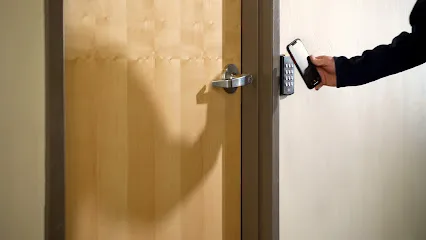
What access-control systems involve
Keypads, card readers, and electronic locks — common in small offices, multi-tenant buildings, and any facility where you need to revoke a single user without rekeying. Ask about hardware compatibility (HID, Mercury, ZKTeco), whether the system is hosted in the cloud or on-premise, and what audit trails it generates.
-
03
What a residential install typically looks like
A standard home job runs 4-8 hours: alarm panel, door/window contacts, motion sensors, glass-break, optionally cameras and smart locks. The pricing model varies — some installers sell equipment, others lease it as part of a monitoring contract. Confirm equipment ownership before signing.
Source attribution — all 7 signals
-
03.
Smart home integration
● On their website
-
04.
Access control
● On their website
-
05.
Residential security
● Listed on Google Maps
-
01.
CCTV
○ Not sure — ask
-
02.
Alarm monitoring
○ Not sure — ask
-
06.
Commercial security
○ Not sure — ask
-
07.
Peace of mind
○ Not sure — ask
Field notes
Snippets pulled from the company's own website and from public reviews — read them as raw evidence, not endorsements.
Official site
"Boise Access Control | Specialize in Access control systems. Home Our Products PDK Access Control System Yale Access Control System Turing A"
PRE-SIGN CHECKLIST
Before you sign a contract
Four things to nail down before equipment goes on your wall — what to ask for, where DIY makes sense, the rule that applies in your state, and the questions every install touches.
1 / Ask for these
- State security-installer license number (so you can verify on the state board website)
- Proof of liability insurance (a million-dollar minimum is normal)
- Brand and model of the panel + cameras they'll install (not just "ours")
- Who actually does the monitoring (in-house vs Rapid Response / Brinks / etc.)
- Whether equipment is sold to you or leased through the monitoring contract
- Contract length, monthly fee, and the early-termination penalty if you cancel
2 / Where DIY can make sense
-
Pure DIY
Ring, Nest Aware, Wyze, SimpliSafe — buy the kit, install it yourself, optionally pay for self-monitoring. Best for renters, small homes, or as a starter setup.
-
DIY install + pro monitor
SimpliSafe Interactive, Cove, abode — you do the install but pay a small monthly fee for a central station. Bridge between DIY and full-service.
-
Pro install + pro monitor
Listings on this directory mostly fall here. ADT, Vivint, local installers like this one. Higher equipment + monthly cost, but they own the install warranty and the monitoring relationship.
-
Full integrator
For commercial sites: card-access doors, fire panels, IT-room monitoring, often integrated with HR provisioning. Specialized firms only — usually different from the residential-focused installers.
3 / The rule in ID
Many states don't have a dedicated security-installer license, so the work falls under the general low-voltage or electrical contractor license. That doesn't make it the Wild West — most cities still require an alarm-system permit before activation, and false-alarm fines are common after the first few false trips. Ask which permit is needed locally and whether the installer files it on your behalf.
4 / Common questions
What does a typical home security install cost?
Equipment + install for a basic 4-sensor alarm panel runs $400-800; cameras add $150-300 each; smart locks $200-400. Monitoring is usually $30-50/month with a 24- or 36-month contract. DIY kits like SimpliSafe start around $250 with optional $15-30/month monitoring.
Do I own the equipment or lease it?
Depends on the installer. Pro installers often lease equipment as part of the monitoring contract — if you cancel, the gear stops working with their app. Buying outright costs more upfront but lets you switch monitoring providers later. Always ask before signing.
How fast does a monitored alarm get a response?
A UL-listed central station calls within 30-60 seconds of a trip to verify, then contacts police or fire if needed. Verification helps cut false-alarm fines. Average emergency-response handoff is 90-120 seconds. Some systems use audio/video verification before any call to police.
What's the difference between a security installer and a fire-alarm installer?
Fire alarms are regulated under separate state and city codes — usually require a different license and inspection trail. Some larger installers do both; many residential security shops don't. If you need an integrated fire + security panel for a small business, ask specifically.
Will my system work during a power outage or internet drop?
A properly installed alarm panel has a battery backup (good for 24+ hours) and a cell radio for monitoring (so it doesn't depend on home internet). Cameras and smart locks usually need power and internet. Confirm both — battery + cellular — before signing.
Do I need a permit to install a home security system?
Many cities require an alarm-system permit before the monitoring company can notify responders on your behalf. Costs are usually $25-100/year, and false-alarm fines kick in after 2-3 trips. The installer typically files the permit on your behalf as part of activation.
At a glance
For security systems needs in Boise, ID, Boise Access Control focuses on Smart home integration, Access control, and Residential security. The location is shown at 590 N Maple Grove Rd #12, Boise, ID 83704, United States. A phone number and website are available for current service, pricing, and scheduling questions.
Service overview
Boise Access Control has a stated focus on Smart home integration, Access control, Residential security, Smart home security integration, and Monitored alarms and access control as part of its security systems work. The relevant scope can depend on the requested service, location, timing, and the information supplied before an appointment or estimate.
The street address shown for the business is 590 N Maple Grove Rd #12, Boise, ID 83704, United States. Direct contact is available by phone and through the company website. Review recent terms and contact information directly when timing, travel, documents, property access, or payment details matter.
Before arranging service, ask who monitors the system, what equipment is supported, what permits or contracts apply, and how false-alarm and service terms are explained. For project work, request a written scope that identifies materials, labor, timing, exclusions, and warranty terms. Clear written answers make it easier to compare the offering with the specific need.